
Gold Price Per Gram: How the Number Is Worked Out
Every gold price you will ever be quoted — by a jeweller, a news bulletin or a rate board — is built from a single number and a single division. The number is the spot price: the world market price of one troy ounce of pure gold, in US dollars. The division is by 31.1034768, the number of grams in a troy ounce. Do that division and you have the 24K gold price per gram. Everything else — karats, tola, rupees — is one more multiplication away.
The worked example
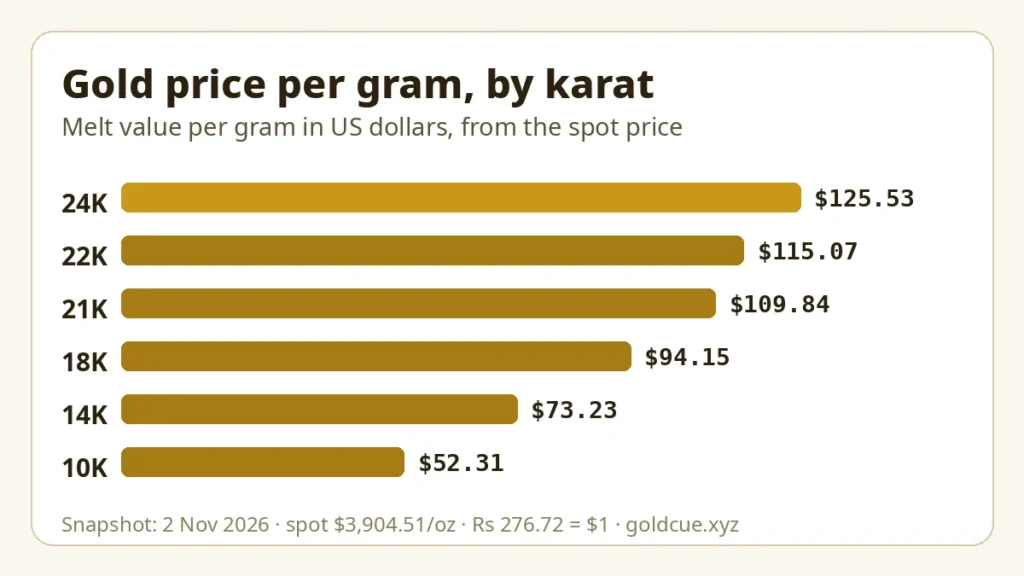
GoldCue’s pages are built on a dated snapshot: Monday 2 November 2026, with the spot price at $3,904.51 per troy ounce. The per-gram calculation is:
$3,904.51 ÷ 31.1034768 = $125.53 per gram of 24K gold.
That is the whole trick. If the spot price moves to $4,000 tomorrow, the same division gives $128.60 per gram — which is why our gold value calculator takes the spot price as an input you can change: type in today’s figure and every price on the page, including the per-gram price, updates. A per-gram price without a date attached is only ever a snapshot; this article is honest about which snapshot it uses, and the calculator removes the need to trust it.
Per gram at every karat
A karat is a purity fraction in 24ths, so each karat’s per-gram price is the 24K price multiplied by that fraction:
| Karat | Purity | Per gram (USD) | Per gram (PKR) |
|---|---|---|---|
| 24K | 100.0% | $125.53 | Rs 34,737.47 |
| 22K | 91.7% | $115.07 | Rs 31,842.68 |
| 21K | 87.5% | $109.84 | Rs 30,395.28 |
| 18K | 75.0% | $94.15 | Rs 26,053.10 |
| 14K | 58.3% | $73.23 | Rs 20,263.52 |
| 10K | 41.7% | $52.31 | Rs 14,473.94 |
The rupee column is the same prices multiplied by the snapshot exchange rate of Rs 276.72 = $1. The full, updateable table — per gram, per tola and per ounce, in both currencies — lives on the karat prices page.
Why the ounce is a troy ounce (and why it matters)
The most common gold-pricing mistake is using the ordinary ounce. A kitchen-scale ounce is 28.35 grams; gold’s ounce is the troy ounce, 31.1034768 grams — about 10% heavier. Divide the spot price by 28.35 instead and you overstate the per-gram price by roughly a tenth, which on a 10-gram purchase is real money. The troy ounce survives from medieval trade fairs, and every exchange, refinery and rate board in the world still uses it. When someone quotes you a per-gram price that looks too good or too bad, check which ounce they divided by.
One more antique unit: the grain
The smallest traditional weight you may still meet is the grain — 0.06479891 grams, used historically for tiny quantities and still printed on some scales. There are 15.432 grains in a gram, so at the snapshot the 24K price per grain is $125.53 ÷ 15.432 = $8.13. You are unlikely to buy gold by the grain, but the conversion closes the set: ounce, pennyweight, gram, grain — every one of them is the same spot price divided or multiplied by a fixed constant, and none of them can change the value of the metal itself. Only the arithmetic changes; the gold does not.
From per gram to per tola
Pakistan and India price gold by the tola: 11.6638038 grams. The per-tola price is just the per-gram price × 11.6638038. At the snapshot, 24K works out to $1,464.19 per tola, and in rupees — the number on Karachi and Lahore rate boards — Rs 405,171 per tola. Local association rates sit close to this converted figure, with small premiums and city differences; our tola price guide rebuilds the Pakistan rate step by step so you can see exactly where any gap comes from.
Per gram price vs what you actually pay
The per-gram figures above are melt value — the worth of the pure gold content. Three adjustments separate them from counter prices:
- Buying jewellery: the shop adds making charges and a margin on top of melt, so you pay more per gram than the table.
- Selling gold: a buyer pays less than melt — typically 70–95% of it — because they test, refine and resell the metal. Our melt value guide explains the spread.
- Coins and bars: investment pieces trade closest to melt, with small premiums that vary by mint and dealer.
The other weight you may meet: the pennyweight
In the US scrap and pawn trade, gold is often weighed in pennyweights (dwt), an old troy-system unit: 1 pennyweight = 1.555174 grams, and 20 pennyweight make a troy ounce. If a buyer quotes you per pennyweight, the conversion at the snapshot is $125.53 × 1.555174 = $195.23 per pennyweight of 24K. The unit changes nothing about the metal — it is the same per-gram price in a heavier coat — but an unfamiliar unit is a classic place for a quiet underpayment to hide. Whatever unit a quote arrives in, convert it back to per gram and compare it against the division at the top of this article.
Why quoted per-gram prices scatter around the true one
On any given day you can find per-gram figures a few percent apart, all claiming to be “the gold rate”. The scatter has mundane causes: some boards quote the bid price (what dealers pay) and others the ask; some use a spot price captured hours earlier; some quote for 999 fineness and others for the 995 fineness of standard bars; and rupee conversions use either the interbank rate or a slightly different market rate. None of this is necessarily dishonest — but it is why GoldCue publishes its methodology and dates its snapshot: a per-gram price you can reproduce beats a per-gram price you must take on faith.
Check any per-gram quote in ten seconds
Take the spot price from any market page. Divide by 31.1034768. Multiply by the karat fraction (22/24 for 22K, 18/24 for 18K). You now hold the honest per-gram melt price, and any quote can be measured against it. That is all GoldCue’s calculators do — the methodology page shows the full method — they just do it for every weight and unit at once, so the arithmetic never gets in the way of the answer.
Prices in this article use the 2 Nov 2026 snapshot (spot $3,904.51, Rs 276.72 = $1) and will differ from today’s market. Enter today’s spot price in the calculator for a current figure.