
1 Tola Gold Price in Pakistan: How the Tola Rate Is Set
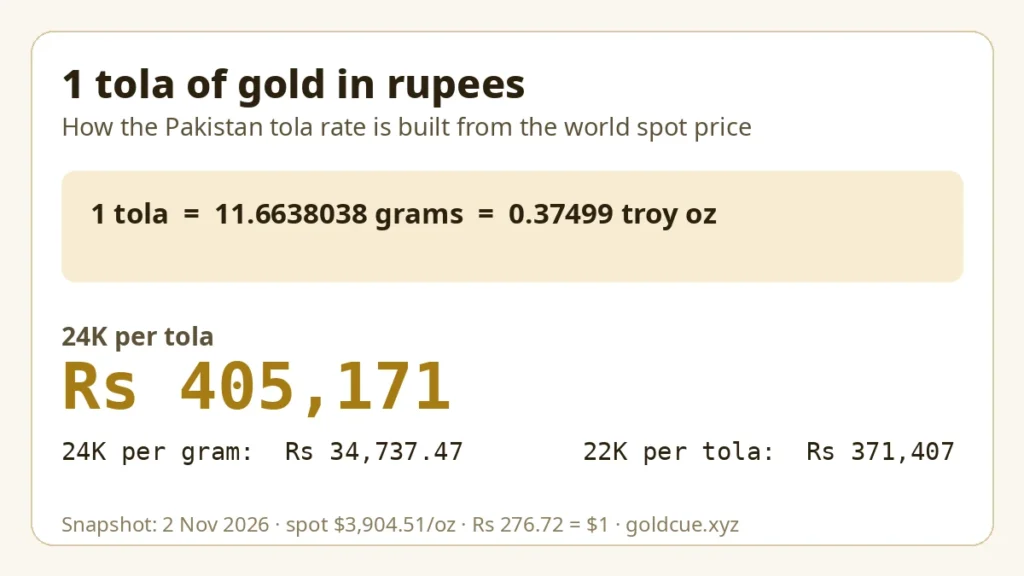
The gold rate announced in Pakistan every morning looks like a single mysterious number. It is not mysterious at all: it is built, in public, from three ingredients anyone can check — the world spot price, a fixed conversion, and the dollar–rupee exchange rate. This guide rebuilds the rate from scratch at GoldCue’s snapshot (Monday 2 November 2026), so that on any other day you can rebuild that day’s rate the same way and see whether the number you are quoted makes sense.
Step 1: the world spot price
Gold trades worldwide in US dollars per troy ounce (31.1034768 grams). At our snapshot the spot price was $3,904.51 per troy ounce. This is the raw material of every gold price on earth; Pakistan’s rate setters start here, and so do we.
Step 2: convert ounces to tola
The tola is the South Asian unit of gold trade: 1 tola = 11.6638038 grams. One troy ounce therefore contains 31.1034768 ÷ 11.6638038 ≈ 2.6667 tola. Pricing one tola from the spot price:
- Spot price per gram: $3,904.51 ÷ 31.1034768 = $125.53 (24K)
- Per tola: $125.53 × 11.6638038 = $1,464.19
That is the 24K price of one tola in dollars. (The same conversion chain is what our gold value calculator runs for any weight.)
Step 3: convert dollars to rupees
Multiply by the interbank dollar rate. At the snapshot, the State Bank rate was Rs 276.72 = $1:
$1,464.19 × 276.72 = Rs 405,171 per tola of 24K gold.
For 22K — the standard for most Pakistani jewellery — multiply by 22/24 first: the dollar price is $1,342.18 per tola, giving Rs 371,406.75 per tola. Per gram, the snapshot figures are Rs 34,737.47 (24K) and Rs 31,842.68 (22K). The complete table, in both currencies and all three units, is on our karat prices page.
Why the sarafa rate is close to — but not exactly — this number
The rate announced by the gold associations (the sarafa rate) starts from the same three ingredients, then the real market gets its say:
- Association premium. The associations build in a margin over the pure converted figure, so the announced rate typically sits slightly above the spot-converted value.
- City differences. Karachi, Lahore and smaller-city rates can differ by small amounts on the same day.
- Timing. The international price moves all day; the announced rate is fixed at announcement time, using the dollar rate of that moment.
- Purity grades. Rates are announced for specific fineness grades; a jeweller pricing 21K or 22K works from those announcements with the karat fraction.
So treat Rs 405,171 as what it is: the spot-converted melt value of a tola at the snapshot — the honest centre that the day’s counter rates cluster around — not a promise of the exact rate at a specific shop counter. For the value of a specific piece you own, melt value is also the right starting point before a buyer’s margin comes off; our melt value guide covers that side of the counter.
The words the counter uses: rawa, banwai, katt
The announced rate prices one thing: 24K gold in its traded wholesale forms — rawa (loose, unpackaged gold) and TT bars. There is no separate per-karat market: a 22K counter price is the 24K benchmark × 22/24, as in Step 3. Around that benchmark, the counter’s vocabulary applies:
- Banwai (making charges) — the labour added when you buy finished jewellery, on top of the metal rate, never inside it.
- Katt (the selling deduction) — what comes off when you sell jewellery back, for solder, wear and refining loss, before your gold is priced.
- The spread — the counter buys below the announced rate and sells at or above it; the gap pays for testing, refining and holding the metal.
None of the three is inside Rs 405,171 — the clean metal value the counter’s arithmetic also starts from. Knowing it tells you exactly how much banwai, katt and spread you are being charged.
Inside the tola: masha and ratti
Older jewellers and many family records still speak the tola’s traditional subdivisions: 1 tola = 12 masha = 96 ratti. In grams, one masha is 11.6638038 ÷ 12 = 0.97198 g, and one ratti is 11.6638038 ÷ 96 = 0.12150 g. If a decades-old family note says a set weighed “5 tola 6 masha”, that is 5.5 tola = 64.15 grams — and at the snapshot’s 22K rate of Rs 371,406.75 per tola, its melt value is Rs 2,042,737.13. Convert the old units first, then price — never guess a weight in a unit you half-remember, because half a tola of confusion is worth more than many people’s monthly salary in gold.
The confusion to avoid: a tola is not 10 grams
Because both numbers circulate in the same shops, they are often treated as interchangeable. They are not: a tola is 11.6638038 grams — 16.6% more gold than 10 grams. At the snapshot, that difference is Rs 405,171 against Rs 347,374.67 for 24K: nearly Rs 58,000. When a price is quoted, the first question is always “per what?” — per tola, per 10 grams, or per gram. Rate boards in Pakistan quote per tola; international coverage quotes per ounce or per gram; our karat table shows all three side by side precisely so the units can never quietly swap.
Checking today’s rate yourself
- Note today’s spot price (any market page quotes XAU/USD) and today’s interbank dollar rate.
- Divide the spot price by 31.1034768 → price per gram.
- Multiply by 11.6638038 → price per tola in dollars.
- Multiply by the dollar rate → price per tola in rupees.
- For 22K, multiply by 22/24 at any point.
Or skip the arithmetic: enter today’s spot price and dollar rate into the value calculator, which does the whole chain instantly — the snapshot defaults in it are ours, but the boxes are yours.
The bottom line for a buyer or seller in Pakistan
Everything in this guide reduces to a habit: never accept a rate as a bare number. Ask which spot price and which dollar rate produced it, rebuild it in the four steps above (or in the calculator), and the difference between the counter rate and your rebuilt rate is the market’s premium — visible, measurable and negotiable at the edges, rather than a mystery you must simply accept. On most days that difference is small, because the associations anchor their announcements to the same world price. On volatile days it can widen — and those are exactly the days when the four steps earn their keep.
A note on dates
GoldCue never presents a stored price as today’s price. The figures in this article are labelled with their snapshot — 2 November 2026 — because a rate guide that hides its date misleads exactly the people it claims to help. Rebuild with today’s inputs and the method in this article gives you today’s number, whichever day you read it.
Figures: spot $3,904.51/oz, Rs 276.72 = $1, 2 Nov 2026 snapshot. Method: methodology.