
22K vs 24K Gold: Purity, Price and Which to Buy
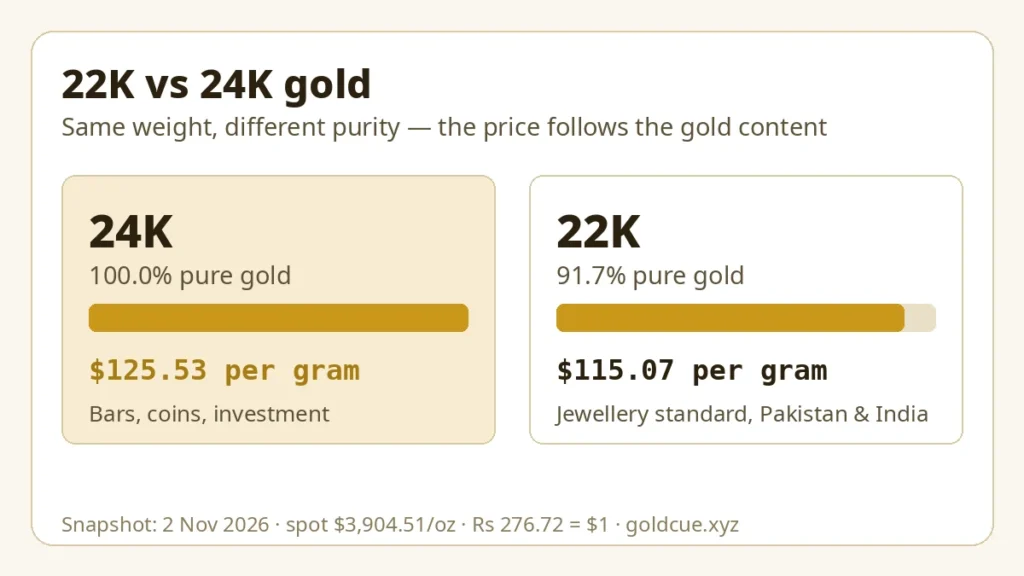
Ask a jeweller which is better, 22K or 24K, and the honest answer is: better at what? The two karats are not rivals so much as tools for different jobs. One is the purest form of gold that exists; the other is gold made practical. Here is the full comparison — purity, price, strength and best use — with the price gap worked out exactly.
The purity difference
Karat counts purity in 24ths:
- 24K is pure gold — the karat fraction is 24/24, shown as 100.0% in price tables (in practice, refined gold is 999 fine, i.e. 99.9%). Nothing is alloyed with it.
- 22K is 22/24 = 91.7% gold, hallmark stamp 916. The remaining 8.3% is alloy metal — typically copper, silver or zinc — added deliberately.
That 8.3% is not cheating or dilution in any shady sense: it is what makes 22K a different material, and it changes both the price and the behaviour of the metal in exact proportion.
The price difference
Because price follows pure gold content, 22K costs exactly 22/24 of the 24K price at any moment. At GoldCue’s snapshot (spot $3,904.51, 2 Nov 2026):
| 24K | 22K | |
|---|---|---|
| Per gram | $125.53 | $115.07 |
| Per tola | $1,464.19 | $1,342.18 |
| Per tola in rupees | Rs 405,171 | Rs 371,406.75 |
The gap is $10.46 per gram — real money on a one-tola purchase (about Rs 33,764 at the snapshot rate), and exactly the value of the gold that is not there. Neither price is “wrong”: you pay for gold content, and 22K contains less of it per gram. What you get in exchange is in the next section. The karat prices page shows every karat side by side, and updates when you enter a new spot price.
The durability difference
Pure gold is soft. A 24K ring bends, scratches and wears thin with daily use; a 24K chain’s links stretch. The alloy in 22K makes the metal noticeably harder and more springy — hard enough for bangles, chains and rings worn every day, which is why 22K became the jewellery standard across Pakistan and India, and why wedding gold is almost universally 22K. 21K (87.5%, the Gulf standard) and 18K (75%) continue the same trade: less gold per gram, more strength — 18K is what holds gemstones securely in their settings.
Which belongs where
- Bars and coins: 24K. Investment gold is bought to be sold by weight, and purity is the whole point. Bars and bullion coins are 24K (999 fine).
- Daily-wear jewellery: 22K. The sweet spot of the South Asian market: over nine-tenths gold, hard enough to live in, and priced transparently by weight wherever you sell it.
- Resale expectations: both resell by the same rule — weight × purity × the day’s rate, minus a buyer’s margin. A 22K piece is not penalised for being 22K; it is simply priced for the gold it contains. What never comes back is making charges, on either karat. Our melt value guide explains what sellers actually receive.
- Gifts and wedding sets: 22K, for the same durability reasons — the set is meant to be worn for decades, not kept in a vault. (If it is kept in a vault anyway, families sometimes choose 24K biscuits instead — a different purchase entirely.)
What the alloy actually does
The 8.3% of a 22K piece that is not gold is not filler — it is engineering. Pure gold is so soft it can be dented with a fingernail’s firm pressure, and it work-hardens poorly, which is why a pure-gold clasp would soon stop springing shut. Copper in the alloy makes the metal harder and gives it a warmer, redder tone; silver pales the colour and keeps it closer to pure gold’s yellow; zinc helps the metal flow when cast. Jewellers tune the mix to the job: a bangle that must survive decades of daily wear gets a harder alloy than a pendant that hangs still. 24K, having no alloy at all, gets none of these adjustments — it is the most beautiful form of the metal and the least practical, and both halves of that sentence are simply metallurgy.
Hallmarks: reading 916 and 999
The comparison is stamped inside almost every genuine piece. 916 means 916 parts per thousand are gold — 22K. 999 means 999 fine — 24K, the practical form of “pure” (refining beyond 999 is possible but not a jewellery category; when price tables show 24K as 100.0%, they are using the karat fraction 24/24, the correct basis for pricing). If a seller describes a piece as 22K but the stamp says 875, it is 21K, and it should be priced as 21K — about $109.84 a gram at the snapshot, between the two karats compared here. The stamp, not the description, is what the price should follow.
Is 24K jewellery ever the right choice?
Mostly no in the South Asian market, and the exceptions prove the rule. In parts of China and the Gulf, high-purity jewellery (often sold as 999 or “chuk kam” gold) is worn proudly despite its softness — pieces are thicker to compensate, designs avoid thin sections and moving parts, and owners accept dents as part of the material’s character. If you love that look, buy it with open eyes: it will not survive the daily-wear life of a 22K bangle, and its resale, while full-valued by weight, may attract questions from buyers used to 22K stock. For a piece that must be both beautiful and inherited intact, 22K remains the considered choice — which is why the market settled there generations ago.
The one-sentence answer
Buy 24K for storing value and 22K for wearing value — and if a seller prices a 22K piece at 24K rates, that $10.46-per-gram gap at the snapshot is the number to point at. Work out any piece’s melt value, in either karat, with the gold value calculator.
Prices: 2 Nov 2026 snapshot (spot $3,904.51, Rs 276.72 = $1). For today’s figures, enter today’s spot price in the calculator. Method: methodology.