
How Much Is 10 Grams of Gold Worth? (Every Karat)
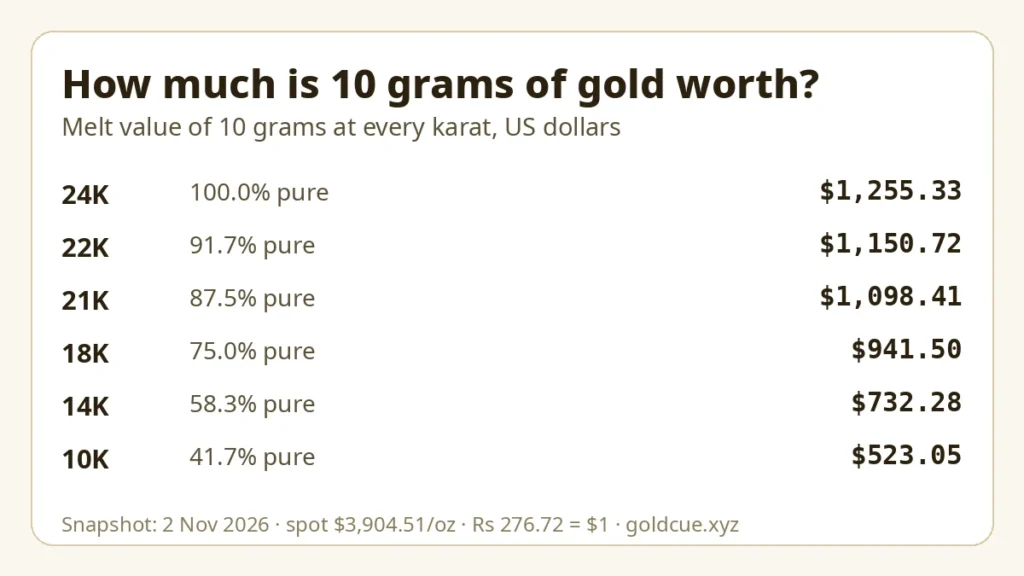
Ten grams is the weight people actually ask about: a chain, a pair of bangles, a small bar, the gold in a drawer. So here is the direct answer, at GoldCue’s snapshot (spot $3,904.51 per troy ounce, Monday 2 November 2026), for pure melt value — the worth of the gold content itself:
The answer, by karat
| Karat | Purity | 10 grams is worth (USD) | In rupees |
|---|---|---|---|
| 24K | 100.0% | $1,255.33 | Rs 347,374.67 |
| 22K | 91.7% | $1,150.72 | Rs 318,426.78 |
| 21K | 87.5% | $1,098.41 | Rs 303,952.84 |
| 18K | 75.0% | $941.50 | Rs 260,531.00 |
| 14K | 58.3% | $732.28 | Rs 202,635.23 |
| 10K | 41.7% | $523.05 | Rs 144,739.45 |
The rupee column uses the snapshot interbank rate of Rs 276.72 = $1. The pattern is the whole story: the value falls in exact proportion to purity, because only the pure gold inside the 10 grams carries melt value. Ten grams of 22K contains 9.17 grams of gold; ten grams of 14K contains 5.83 grams. Price the gold, and you have priced the piece. (Rupee values are shown to the paisa as the calculator computes them; in practice a tola-denominated counter quote would be rounded and carry the day’s association rate.)
Where the headline number comes from
The 24K figure is two operations: the spot price divided by the grams in a troy ounce gives the per-gram price — $3,904.51 ÷ 31.1034768 = $125.53 per gram — and ten grams multiplies it by ten: $1,255.33. Every other row applies the karat fraction. Our gold price per gram guide walks through the method, and the karat price table shows the same figures per gram, per tola and per ounce.
Any other weight works the same way
Because the maths is linear, scaling is trivial once you have the per-gram price:
- 5 grams of 22K: half of $1,150.72 = $575.36
- 20 grams of 18K: $1,882.99 (the calculator works from the unrounded per-gram price, so it can land a cent away from doubling the rounded 10-gram figure)
- 1 tola of 24K (11.6638038 g): $125.53 × 11.6638038 = $1,464.19 — the tola figure in detail in our Pakistan tola guide
Or skip the scaling entirely: the gold value calculator accepts any weight in grams, tola, troy ounces or kilograms, at any karat, and updates the moment you type today’s spot price over the snapshot.
What 10 grams looks like in the real world
Ten grams is roughly: a man’s wedding band and a woman’s ring together; one medium chain without a pendant; a pair of small bangles; or a small minted bar (bars are commonly sold at exactly 10 g and at 1 tola). If you are estimating a piece you own, weigh it — kitchen scales read to the gram, which is close enough to place you in the right row of the table, though clasps, springs and stones included in the weight will nudge the true gold content down slightly.
Ten grams in the other units
Ten grams is 0.8574 tola and 0.32151 troy ounces — worth knowing because two common confusions live here. First, a tola is not 10 grams: it is 11.6638038 grams, nearly 17% more, so a “one tola” piece and a “10 gram” piece differ by $205 in 24K melt value at the snapshot ($1,464.19 against $1,255.33). Second, a 10-gram bar and a 10-gram piece of jewellery are priced by the same table but bought and sold differently: the bar trades near melt both ways, the jewellery carries making charges in and a buyer’s margin out.
A drawer audit, worked end to end
Suppose the drawer holds two pieces: a 4-gram ring stamped 916 (22K) and a 6-gram chain stamped 750 (18K). Priced separately at the snapshot:
- Ring: 4 g × $115.07 = $460.29
- Chain: 6 g × $94.15 = $564.90
- Combined melt value: $1,025.19
That combined figure — computed before any buyer sees the pieces — is the anchor for any conversation about selling them. An offer near 70–95% of melt ($718–$974 across the two) is within the normal negotiation range our melt value guide describes; an offer below it needs a reason. Note also what the audit did not need: no appraisals, no paperwork, no trust in anyone’s screen. A scale, two stamps and the per-gram price did the whole job.
Coins people actually hold: the sovereign test
A common drawer item is the British sovereign — the gold coin in many Pakistani and Indian family collections. A sovereign is not 10 grams: it weighs 7.9881 grams at 22K, so by this article’s table its melt value at the snapshot is 7.9881 × $115.07 = $919.21. Two warnings follow. First, sovereigns are exactly the kind of item that can be worth more than melt — older or rarer dates attract coin collectors — so a melt-price offer for a sovereign deserves a numismatic second opinion. Second, the opposite trap exists: common-date sovereigns in worn condition genuinely do trade near melt, and no amount of family lore changes that. Weigh, check the karat, price the melt — then decide whether the coin’s story is worth more than its gold.
Melt value vs what you would be paid
The table is melt value. Selling those 10 grams to a jeweller or gold buyer returns less — typically 70–95% of melt, after testing and refining margins; buying 10 grams of new jewellery costs more than melt once making charges are added. The melt value guide explains the spread and how to negotiate from the melt figure instead of from the buyer’s opening number.
A word about dates
Gold moves daily, so treat the table as an exactly-worked example at a stated date, not a standing quote. The method, however, never goes stale: divide today’s spot price by 31.1034768, apply the karat fraction, multiply by your weight — or let the calculator do it. The methodology page documents every constant we use.
Figures: 2 Nov 2026 snapshot (spot $3,904.51, Rs 276.72 = $1).