
Melt Value: What Your Gold Is Worth to a Jeweller
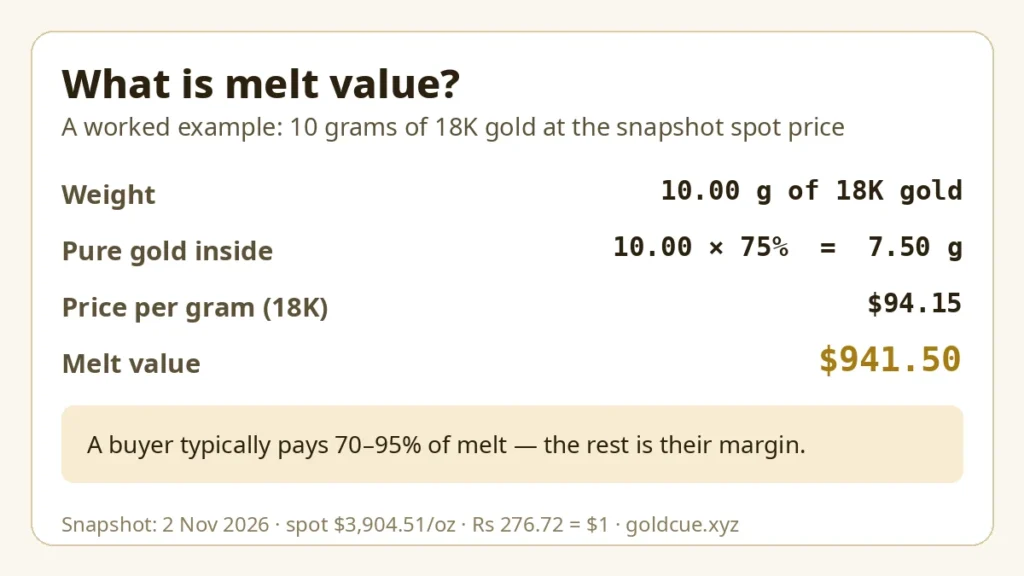
Before you sell a chain, a ring or a broken bangle, there is one number you should know better than the buyer hopes you do: its melt value. Melt value is the market worth of the pure gold inside the piece — what the metal itself would fetch if it were melted down and sold as raw gold. It is not what you will be paid. It is the number every offer you receive is negotiated down from, which is exactly why it is the number to walk in holding.
The formula
Melt value = weight × purity fraction × spot price per gram.
Three inputs, all checkable:
- Weight in grams. A kitchen scale is close enough for an estimate; a jeweller’s scale settles the final figure.
- Purity fraction from the karat: 22K = 22/24 = 91.7%, 18K = 75%, 14K = 58.3%. The hallmark stamp inside the piece states it in thousandths — 916, 750, 585.
- Spot price per gram: the world spot price per troy ounce divided by 31.1034768. At GoldCue’s snapshot (2 Nov 2026, spot $3,904.51), that is $125.53 for pure gold.
A worked example
Take a 10-gram chain stamped 750 — 18K gold:
- Pure gold inside: 10.00 g × 75% = 7.50 g
- Price per gram at 18K: $125.53 × 75% = $94.15
- Melt value: 10 × $94.15 = $941.50
Run your own piece through the same steps with the gold value calculator — it takes grams, tola, troy ounces or kilograms, every karat, and a spot price you can update to today’s. For the full price table behind the example, see gold prices by karat.
Why you will be offered less
A buyer is not a charity with a furnace. Between your chain and raw gold bars sit real costs and real risks: testing the metal (and the risk the stamp lies), refining it back to pure gold, holding it while prices move, and running a shop. So offers land below melt — typically between 70% and 95% of it, with the position in that range depending on the buyer, the item and how easily it can be resold as-is rather than melted.
On the worked example, that range is roughly $659 to $894 against a $941.50 melt value. An offer inside the range is a negotiation. An offer far below it — half of melt, say — is information: the buyer is hoping you do not know the number. Now you do.
What melt value ignores (in both directions)
- Gemstones are usually priced at little or nothing by gold buyers, however much they cost new. A stone with real value belongs in front of a gem buyer, not a gold scale.
- Making charges are gone the moment you buy. They were payment for craftsmanship, and melt value never includes them.
- Brand and antique value can push a piece above melt — a recognised maker’s piece or a genuinely old coin may be worth more intact than melted. If a buyer is suspiciously eager, that is worth a second opinion before selling.
- Solder and springs in clasps are not gold; heavy findings slightly reduce real content below the stamped estimate.
How a buyer tests your gold (and why it affects the offer)
Serious buyers do not trust the stamp alone, and the testing ladder explains part of the discount. The first rung is the touchstone and acid test: the piece is rubbed on a black stone and acids of known strength are applied to the streak — cheap, quick, and it only samples the surface. The second is density testing, weighing the piece in air and water; gold’s density (19.3 g/cm³) is hard to fake, though tungsten-core counterfeits are designed to challenge exactly this test. The top rung is XRF analysis, a scanner that reads the alloy’s composition in seconds without damaging the piece. A buyer with an XRF machine can offer closer to melt with confidence; a buyer testing by acid and experience prices in more uncertainty — one practical reason offers differ between shops for the identical chain.
Coins and bars sit closer to melt
Everything above is written about jewellery, the hardest case. Minted bars and well-known bullion coins are the easy case: their weight and purity are guaranteed by the mint, they need no refining decision, and they resell the day they are bought in. Offers for them typically sit at the top of the melt range or even carry a small premium over it, and selling prices sit only modestly above melt. If part of what you hold is a bar or coin, do not let it be averaged into a jewellery-style offer — it deserves its own, better number.
Selling without being undersold
- Weigh and stamp first. Know your grams and your karat before anyone quotes you.
- Compute melt at today’s spot price, not ours — our snapshot is dated (2 Nov 2026), and the calculator accepts today’s figure.
- Get two offers. The gap between buyers is often wider than the gap between melt and a fair offer.
- Ask what percentage of melt the offer is. A buyer who will not answer that question has answered it.
- Separate the stones. If a piece has significant gemstones, have them assessed separately first.
An edge case: plated and gold-filled items
Melt value belongs to solid karat gold. Gold-plated items carry a surface layer measured in microns — their gold content is negligible and their melt value is effectively zero, whatever the underlying object is worth as an object. Gold-filled items (marked “GF” with a fraction such as 1/20) carry a mechanically bonded layer that is a stated fraction of the item’s weight; a heavy gold-filled piece can hold a real, if modest, amount of gold, and a specialist buyer can price it — but never at the solid-karat table. If a piece carries no karat stamp and no hallmark, assume the burden of proof is on the gold, not on the buyer.
The honest summary
Melt value is the honest middle number of the gold trade: jewellers buy below it and sell above it, and every fair price in the market is anchored to it. GoldCue’s calculators exist to put that number in your hand — dated, checkable and reproducible from the methodology we publish. Walk in knowing it, and the negotiation starts from your number instead of theirs.
Example figures: 2 Nov 2026 snapshot (spot $3,904.51, Rs 276.72 = $1). This guide is information, not financial advice.